A restaurant owner, an event organizer, a brand operator, and a touring musician all have the same software problem. Here's what it's actually costing — and what a connected system does instead.
The part nobody warns you about
Nobody opens a restaurant because they love reconciling reports. Nobody starts a band, launches a hot sauce, or throws their first block party because they wanted to own four software subscriptions.
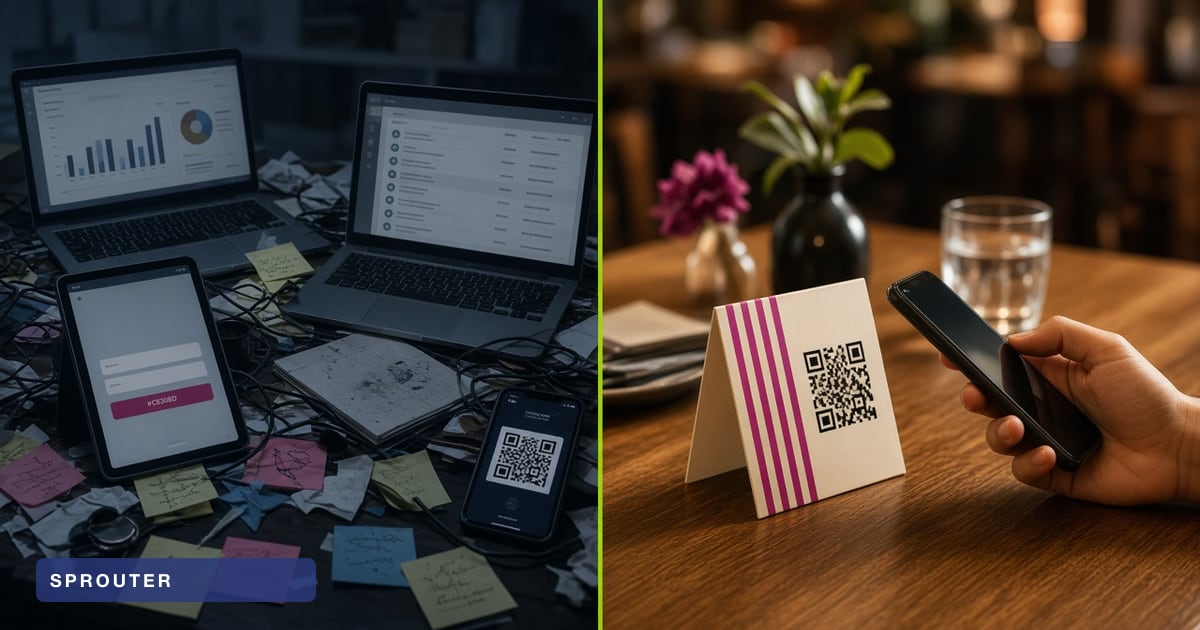
But that’s where almost everyone ends up. One tool for an Action Page. One for Dynamic QR Codes. One to sell tickets. Something to take payments. A spreadsheet holding it together. Four logins, four bills, four support relationships, four dashboards that each know one-quarter of your business and none of which will talk to the others.
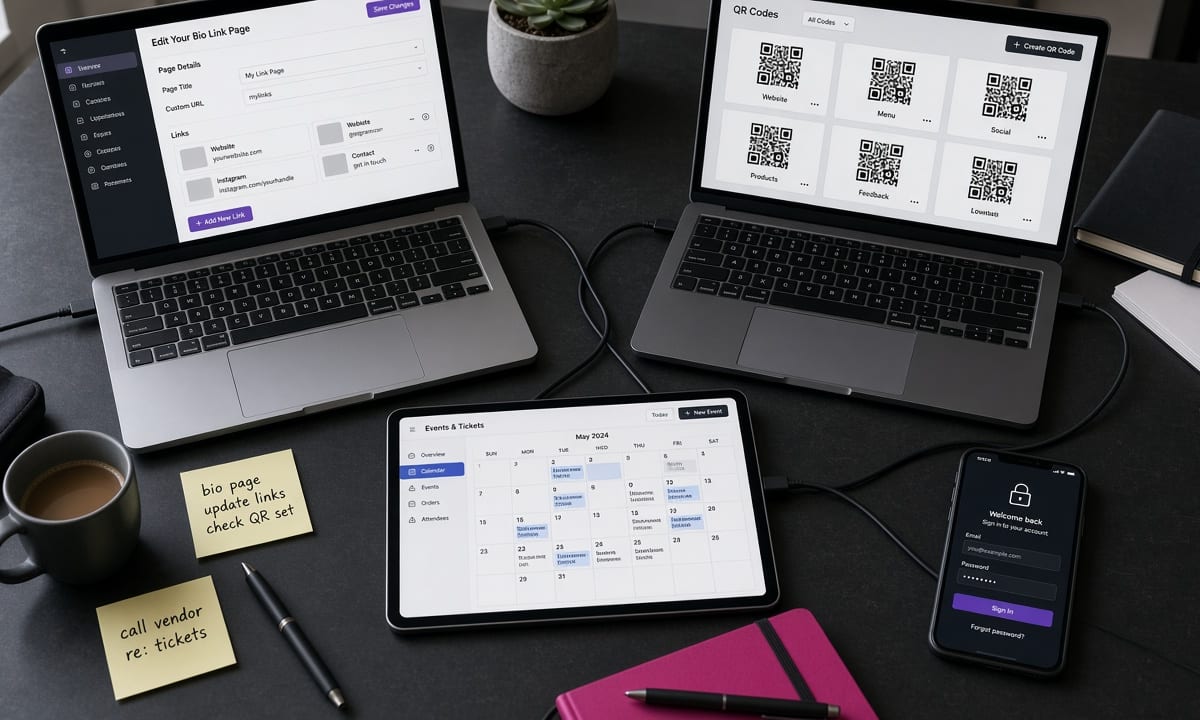
And here’s the part that stings: none of the individual tasks are hard. Putting a menu on a phone is not hard. Selling a ticket is not hard. Making a QR code is genuinely easy. These are simple jobs. They only became complicated because they got sold to you by four different companies.
That’s not a you problem. That’s an architecture problem. And it has a price.
What the fragmented stack actually costs
The invoice is the part everyone can see. Subscriptions stack. Ticket fees compound. You pay four vendors to do jobs that should be one job.
We are not going to invent a third-party dollar table here. Published Sprouter figures live on the Fee Schedule (effective July 21, 2026) and Pricing. For a side-by-side with major-platform ticketing, see Comparing Eventbrite Fees. Your numbers move with plan, ticket price, volume, and whether you pass fees to buyers or absorb them.
| Line | Public figure |
|---|---|
| Pro+ platform fee | 1% + $0.10 per ticket, capped at $5 |
| Processing | 2.9% + $0.30 per order |
| Free events | No platform fee on any plan |
Those lines are the ones on the Fee Schedule. They are not a claim that every operator saves a specific annual amount. They are the published filter on which events are allowed to happen at all — especially the $10 community night and the free tasting with an RSVP.
But the money is the smaller half of the bill.
The two costs that never show up on an invoice
Your time. A Harvard Business Review study tracking knowledge workers found they switch between applications and windows roughly 1,200 times a day, losing about four hours a week just to reorienting themselves. Treat that as modeled third-party research, not a Sprouter customer outcome. Even if only part of that switching is a fragmented tool stack — the double data entry, the manual reconciliation — it still arrives as a Sunday night, not as a line item.
The answers you can’t get. This is the expensive one. With four separate tools, there are questions you simply cannot answer at any price:
- Which poster sold the tickets? The QR company can’t see the ticket sales.
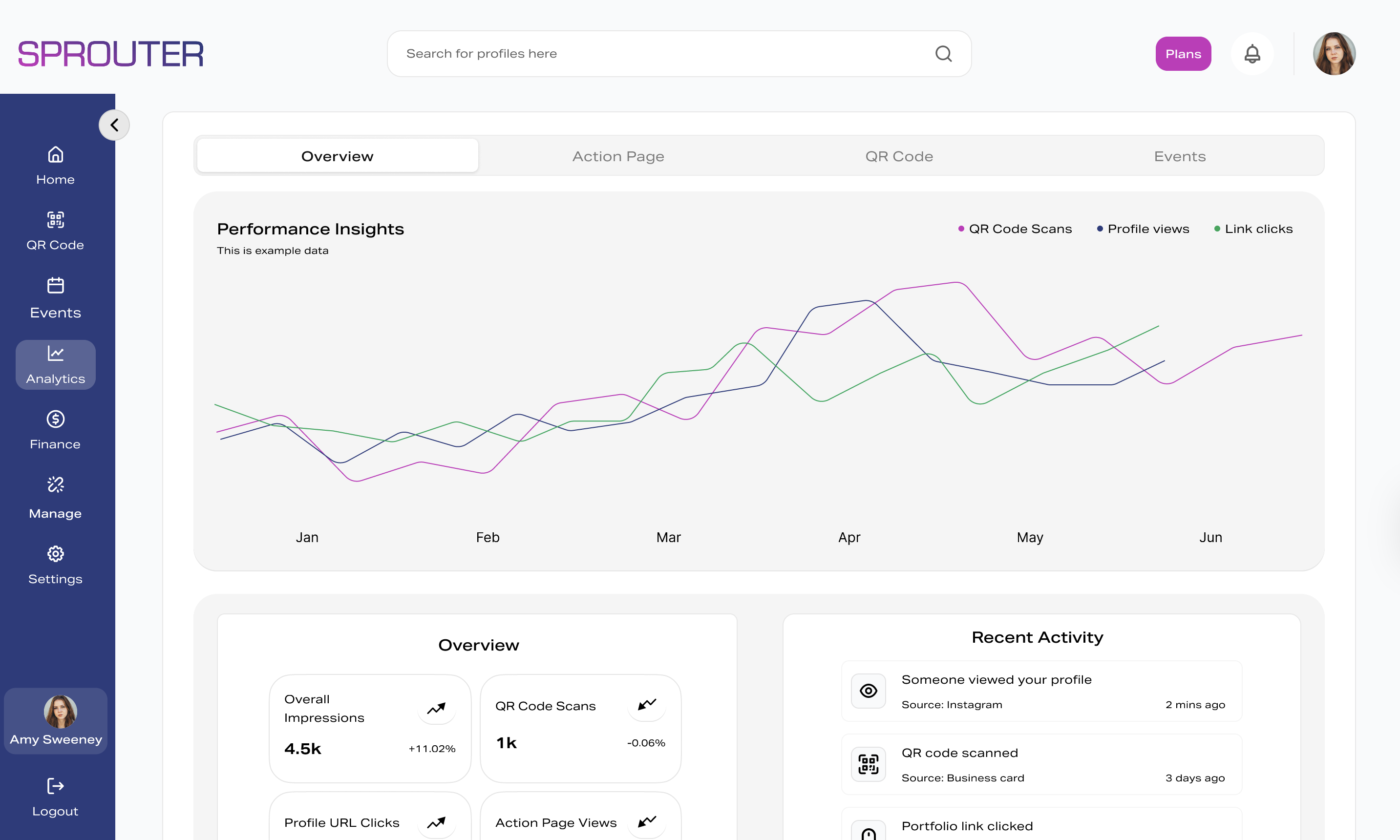
- Do the patio codes get scanned more than the bar codes? Not if every table points to the same code.
- Who came to the last three events? The ticketing platform has emails. It doesn’t have a relationship you can use.
- Did the Instagram push or the table tent drive Thursday’s crowd? Nobody knows. Everybody guesses.
You’re not missing a report. You’re missing the joins between systems that were never built to connect.
You cannot buy those joins from anyone, in any combination, because a QR vendor cannot see a marketplace’s sales and a marketplace cannot see a QR vendor’s scans.
Why the field isn’t level
Here’s the uncomfortable truth about how big chains stay ahead.
It’s rarely a better product. A twelve-location group does not make a better cocktail than the neighborhood bar. A national brand does not make better salsa than the person shipping it out of a commissary kitchen. What they have is a data team, an integrations budget, and someone whose entire job is making four systems talk to each other.
That’s it. That’s the moat. They can afford to buy the connective tissue that the software industry refuses to include, and you can’t — so they know which promotion worked and you’re running on instinct.
Instinct is not nothing. Operators who have been doing this twenty years have instincts a spreadsheet will never match. But instinct plus evidence beats instinct alone, every time, and right now evidence is priced like an enterprise feature.
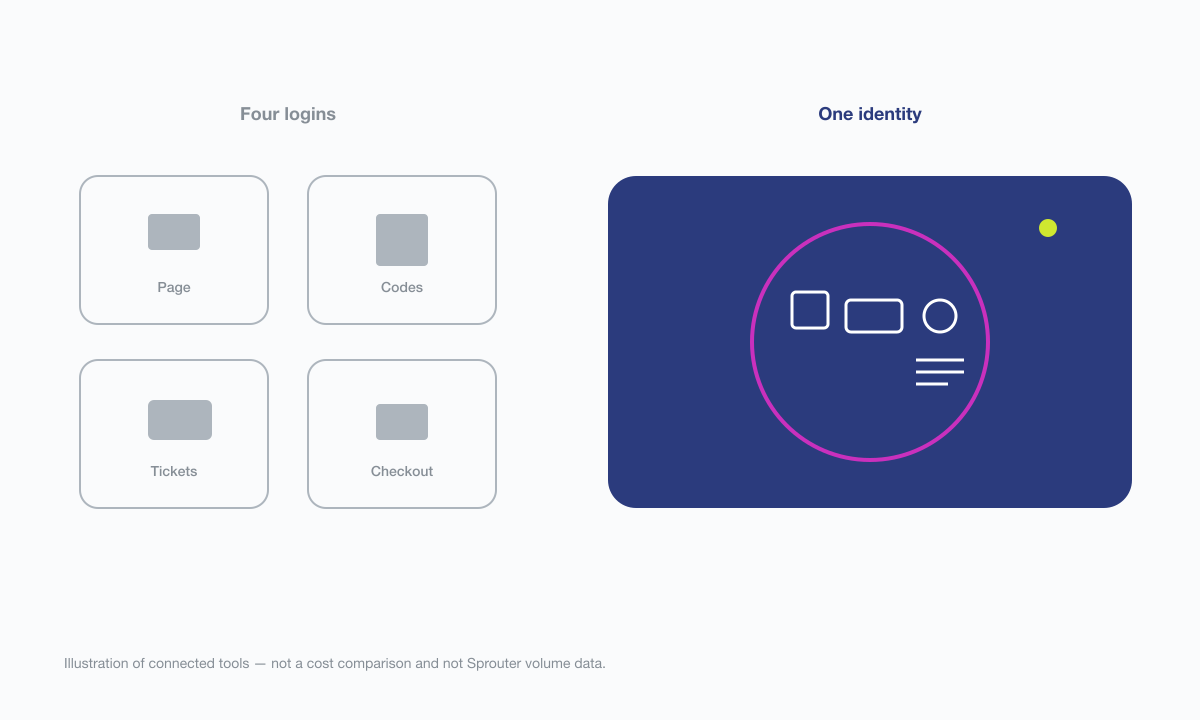
That’s the thing we’re actually trying to fix. Not “make a nicer QR code.” Give an independent operator the same connected picture a national chain pays six figures a year for, at a price that fits a business with one location and no IT department.
A level field doesn’t mean everyone wins. It means you lose to a better restaurant, not to a better integrations budget.
What connected and simple looks like in practice
Not a feature list. One story.
A restaurant puts a Sprouter code on every table — a different code for the patio, the bar, and the dining room. Guests scan for the menu. Within a week the owner can see the patio codes get scanned twice as often as the bar codes, which is useful information about where to put the specials.
The menu page also shows Thursday’s wine tasting. A few guests buy tickets right there, while they’re sitting at the table, already thinking about this restaurant. Event-ticket checkout is processed by a payment processing partner on the same flow, so the buyer is not sent to a second login. Those guests now follow the restaurant.
After the tasting, the owner messages everyone who came about next month’s dinner series. No algorithm deciding whether the message gets shown. No ad spend.
In September the menu changes. The codes stay exactly where they are. Nothing gets reprinted, ever.

Count the tools in that story. One. Count the new skills the owner had to learn. Zero — they changed a menu and sent a message.
Every step fed the next one. That’s the whole idea. Not more software. Software that knows about itself.
Your industry, specifically
Restaurants, bars, and hotels
The problem is usually the same three things: reprinting costs money every time a price changes, one aggregate scan number tells you nothing about which room is working, and your regulars live in your memory instead of in something you can actually message.
What changes: a distinct Dynamic QR Code per table, window, or patio, all retargetable without reprinting. Menus, reservations, and specials on one Action Page, with an OpenTable® reservation widget. Links that appear and expire on a schedule, so the brunch menu shows up Saturday morning across every table at once and disappears Sunday night. Ticketed tastings, trivia, and live music sold from the same page. Analytics that tell you which placement performs, by hour and by day.
Event organizers
Fees and float are the whole conversation. Legacy ticketing typically runs a percentage plus a fixed amount per ticket, and that fixed component is what quietly destroys small events — a fee that reads as a low percentage behaves like double digits on a $25 community ticket.
What changes: on Pro+, 1% + $0.10 per ticket capped at $5, plus 2.9% + $0.30 processing per order. Free events carry no platform fee on any plan, including the free plan. Eligible organizer proceeds go by ACH to the linked bank account, typically 1–3 business days after payout initiation. Check-in runs on the same account that sold the ticket, so the door and the sales data are never out of sync. And because the promotion and the ticketing live in one system, you finally know which flyer, which table, which post actually sold the seats.
Brands and packaging
If you sell a physical product, retailers own the transaction data and you own almost nothing about the person who bought it. Meanwhile GS1 Sunrise 2027 is coming on a schedule, and the EU’s Digital Product Passport is coming behind it.
What changes: one GS1 Digital Link 2D barcode that does both jobs — identifies the product, batch, and expiration at checkout, and opens a branded page on a shopper’s phone. Update that page whenever you want without touching the packaging, which matters when your print cycle is twelve to eighteen months and a regulation, a recall, or a holiday campaign does not wait for it. Enterprise integrations often exceed six figures. Sprouter’s connected packaging starts at $500/month and includes the destination, the analytics, and the rest of the platform.
Creators, artists, and performers
Tool sprawl in its purest form: an Action Page here, a QR generator there, a ticketing platform for shows, something else for merch, and no single place that shows you what’s working.
What changes: one hub for links, drops, and shows, with ticketing built into the page itself. Trackable codes on merch and at the table. People who buy a ticket can follow you — which means your next show reaches them directly, instead of depending on whether a feed decides you’re worth showing that day. The list is yours.
Multi-location and franchise operators
The pain is consistency and visibility: every location doing it slightly differently, three to six vendors in the stack, and no single view across any of it.
What changes: standardized pages and templates across locations, white-label options on Enterprise, unified cross-location reporting, and one vendor relationship and one compliance surface instead of six.
What it costs, plainly
Plans are on Pricing: start free, then Pro and Pro+ as you need scheduling, Dynamic QR Codes, and the published platform-fee lines. No credit card to start. Free events carry no platform fee on any plan, permanently. Ticket platform and processing figures are on the Fee Schedule, not restated as a second plan matrix here.
For the product philosophy behind why those pieces belong on one identity, see More Social. Less Media..
What we won’t tell you
Three honest limits, because you’ll find them anyway and you should hear them from us.
We don’t send you a crowd. Large ticketing marketplaces have a browsing audience, and some of the fee you pay them buys discovery. We don’t have that. Sprouter is built for operators who already have an audience, or who want to build one they own rather than rent.
You can get pieces of this for free. Absolutely true. If you need a personal page with five links on it, a free tool is the right answer and you should use one. The case for a connected system only starts when you need the QR code to know about the event, and the event to know about the audience.
A specialist tool will beat us inside its own lane. A dedicated ticketing platform has more ticketing features. A dedicated QR platform has more QR features. What none of them has is the part between the lanes, and for most operators the part between the lanes is where the money and the hours are going.
The actual point
Everything above is mechanics. Here’s the reason any of it matters.
The most valuable thing in your business is not your software. It’s the ten seconds where someone at table 14 looks up from a menu and decides they like this place. It’s the person at the door who came because a friend told them to. It’s the shopper who turns your package over because they want to know who made this.
Those moments are real, they involve actual human beings, and they are getting rarer and more valuable as more of the internet fills up with things that aren’t people. You should not be spending your Sunday night in a spreadsheet trying to reconstruct what happened during them.
Simple things should stay simple. The tools should do the connecting. You should get to do the part you actually got into this for.
Turn every scan, tap, and click into measurable action.
Start free at getsprouter.com. Or contact us and we’ll walk through your stack against the published Fee Schedule.
About Sprouter
Sprouter LLC is an all-in-one engagement, ticketing, Dynamic QR, and analytics platform based in Phoenix, Arizona, founded in 2016. Sprouter combines Action Pages, Dynamic QR Codes and NFC, event ticketing, audience tools, and analytics on a single user identity, with a GS1 Digital Link resolver for connected packaging. Event-ticket payments are processed by a payment processing partner. The platform is available on web, iOS, and Android, with a separate scanner app for event check-in. Learn more at getsprouter.com.
Press inquiries: press@getsprouter.com.
Sources
- Sprouter Fee Schedule, 21 July 2026
- Sprouter Pricing
- Comparing Eventbrite Fees
- More Social. Less Media.
- GS1 Digital Link; GS1 Sunrise 2027; EU Digital Product Passport
- Harvard Business Review research on application switching (modeled time cost; not a Sprouter customer outcome)
Disclosures
Sprouter is not a bank. Event-ticket payments are processed by a payment processing partner. Platform and processing fees are disclosed at checkout and on the Fee Schedule; free events carry no platform fees on any plan. Fee figures reflect the getsprouter.com Fee Schedule dated 21 July 2026 and are subject to change. Cost and savings comparisons depend on plan, ticket price, volume, and fee-absorption settings; individual results vary. Time-savings figures are modeled from published third-party research on application switching, not measured Sprouter customer outcomes. OpenTable® is a registered trademark of its respective owner; reference to the integration does not imply endorsement. GS1 Digital Link and related standards are administered by GS1; compliance requirements and timelines are set by GS1 and applicable regulators, not by Sprouter. This article contains forward-looking statements about markets and product that are inherently uncertain; actual results may differ materially.