We built Sprouter in Phoenix in 2016 on a slogan that sounded like a contradiction. Ten years later, it's the only sane thing left to say.
The original idea
Sprouter started in Phoenix in 2016. The slogan was more social, less media.
People found that confusing at the time. It was 2016. Digital was social. Every platform was promising more connection, and most people still believed them.
What we meant was narrower and, it turns out, more durable: the digital part should get out of the way. Screens should be a shorter path to a person, a place, or a thing — not a destination you get stuck in. Less friction, less noise, less time staring at an interface. More of the actual thing you opened it for.
Creators, venues, and organizers were already piecing together a dozen tools to do that. Ten years later, nobody finds the slogan confusing.
What “digital experience” turned into
Somewhere along the way the industry decided that a digital experience is a sequence of things done to someone.
You know the sequence, because you’ve been on the receiving end of it this week. A cookie banner before you can read anything. A pop-up over the article you came for. An email capture that appears at 40% scroll. A countdown timer that resets when you reload, which everyone now knows and nobody believes. A chat bubble asking if you need help before you’ve seen anything to need help with. Then three weeks of retargeting because you looked.
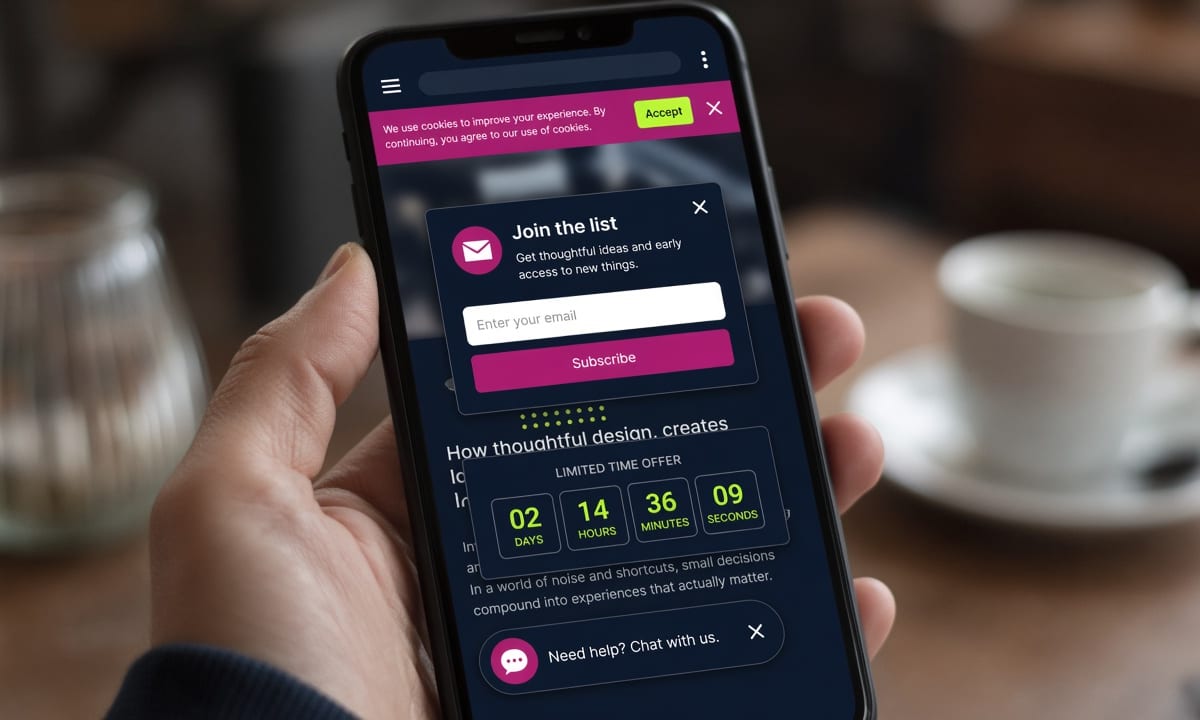
Every one of those is a small tax on a person’s attention, collected before any value has been delivered. And the whole apparatus was built on a simple assumption: attention is cheap, people can be nudged, and if you push hard enough at a single conversion point, some percentage converts.
That assumption is now visibly false. Click-through rates are measured in hundredths of a percent. A third of people run ad blockers. Engagement across platforms keeps falling. This isn’t a targeting problem you fix with a better tool. It’s people saying no, and every escalation makes them say it faster.
The tactics didn’t stop working because they were poorly executed. They stopped working because they were never for the customer.
The dead end nobody talks about
There’s a second failure that gets less attention and causes more damage.
Almost every digital experience a business creates is a single endpoint. It does one thing and then it stops.
A QR code on a table opens a PDF menu. That’s it. The person reads it and the experience is over — no path to the wine tasting on Thursday, no way to hear about the next one, no idea on your end who looked at what.
A ticket confirmation lands in an inbox. That’s it. The transaction completed and the relationship ended in the same second.
A code on a package opens a page that was built for a campaign that ended nine months ago, and nobody remembers who has the login to change it.
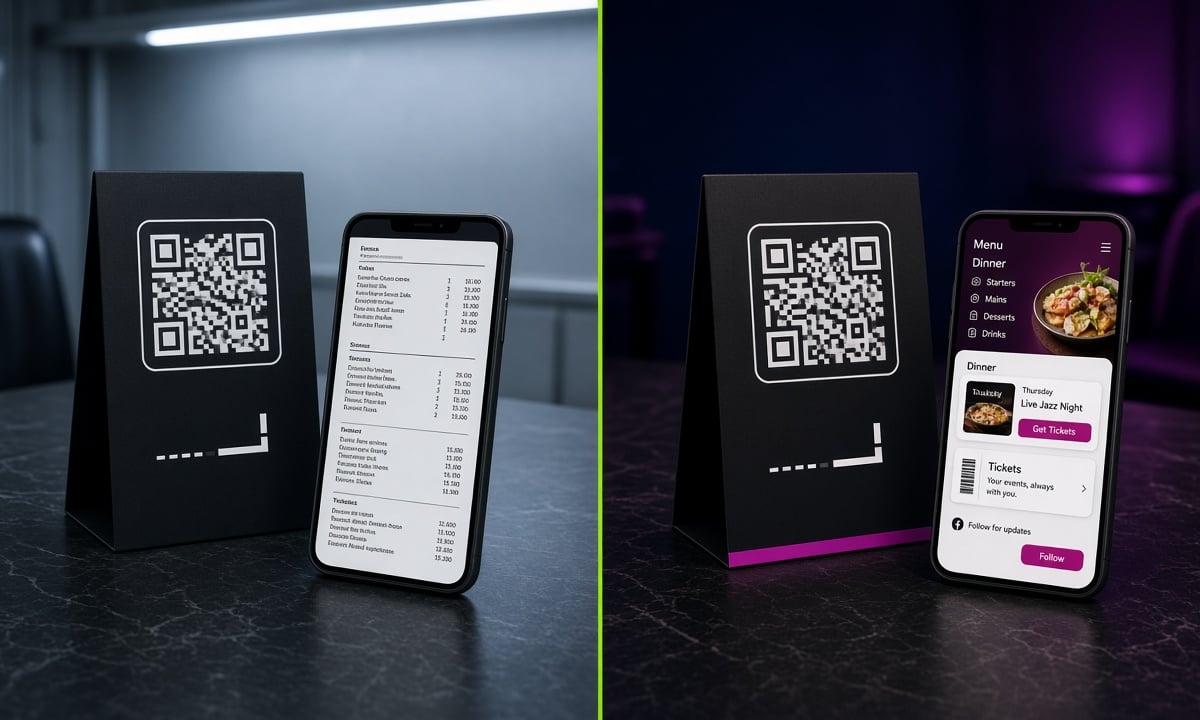
Each of these is a cul-de-sac. The person arrived, got one thing, and left. Whatever they might have wanted next, there was no next.
That’s not a customer’s failure of interest. It’s a design decision — usually an accidental one, made because the tool that created the code has no idea that the events exist, and the tool that sells the tickets has no idea the code exists.
What people actually need, when they need it
Here’s what changes everything, and it’s almost embarrassingly simple.
When someone scans a code, taps a poster, or turns over a package, they have already told you what they want.
The person scanning the menu wants the menu. The person tapping the poster wants tonight’s show. The person holding your product wants to know what’s in it, where it came from, or how to use it. Nobody scanned anything by accident.
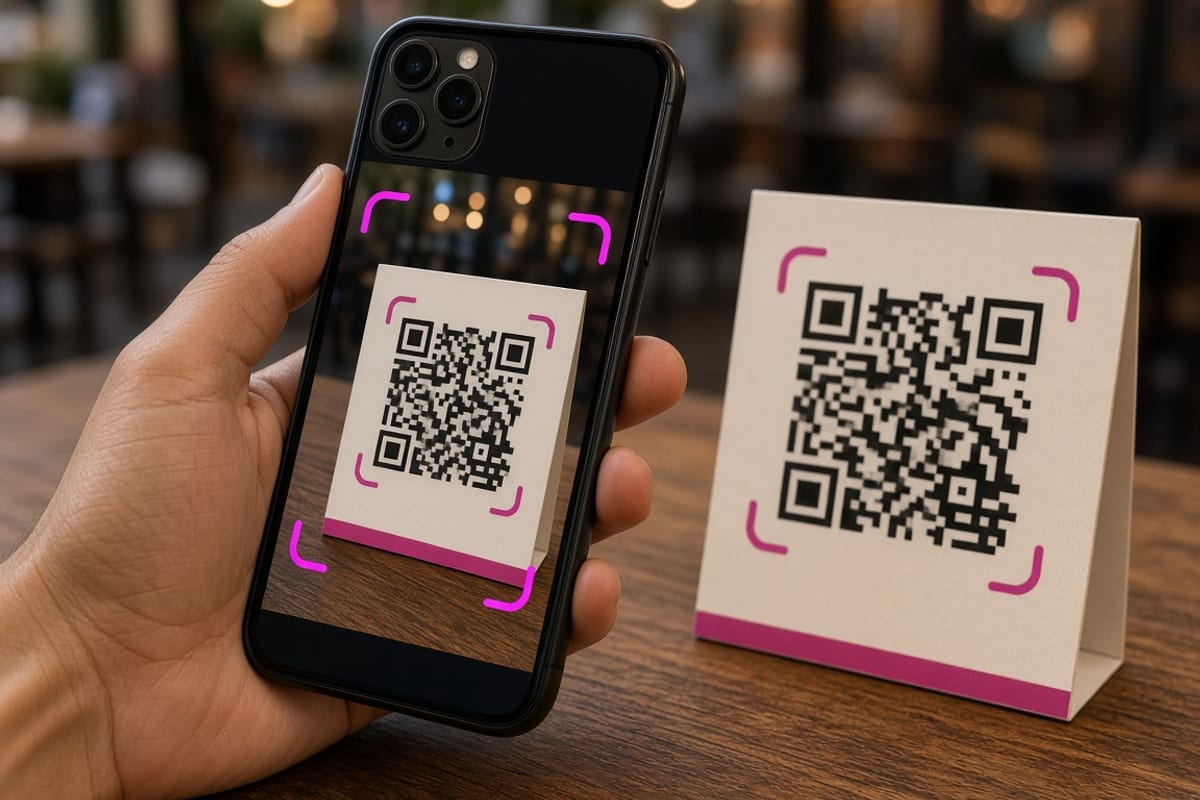
This is invited attention, and it is the rarest thing in commerce right now. You don’t need a countdown timer to create urgency in someone who is standing in your restaurant looking at your menu. You don’t need a pop-up to capture someone who just deliberately pointed their camera at your packaging. They’re here. They asked.
The job is not to extract something from that moment. The job is to serve it well and let it lead somewhere.
Serve it well means: the page loads fast, it’s not gated, it shows the right thing for right now, and it works on the phone they actually have. The brunch menu appears Saturday morning and goes away Sunday night without anyone touching anything. The ticket can be added as a digital pass on Apple or Google and scan at the door even when the venue has no signal. A friend who can’t come can pass their ticket along without a chain of forwarded emails.
Let it lead somewhere means: the menu also knows about Thursday. The ticket also means you’ll hear about the next show, if you want to. The package also connects to the people who made it. Not as a sales funnel — as a path that continues instead of stopping.
That’s the whole product philosophy. Make the moment better for the person. Everything else follows from it.
Both sides have to get something
Most platforms treat the person on the other end as a tracking event. Make them create an account so we can follow them. People can feel that trade, and they’re right to resent it.
So the test we hold ourselves to is: would someone want this account even if it did nothing for the business?
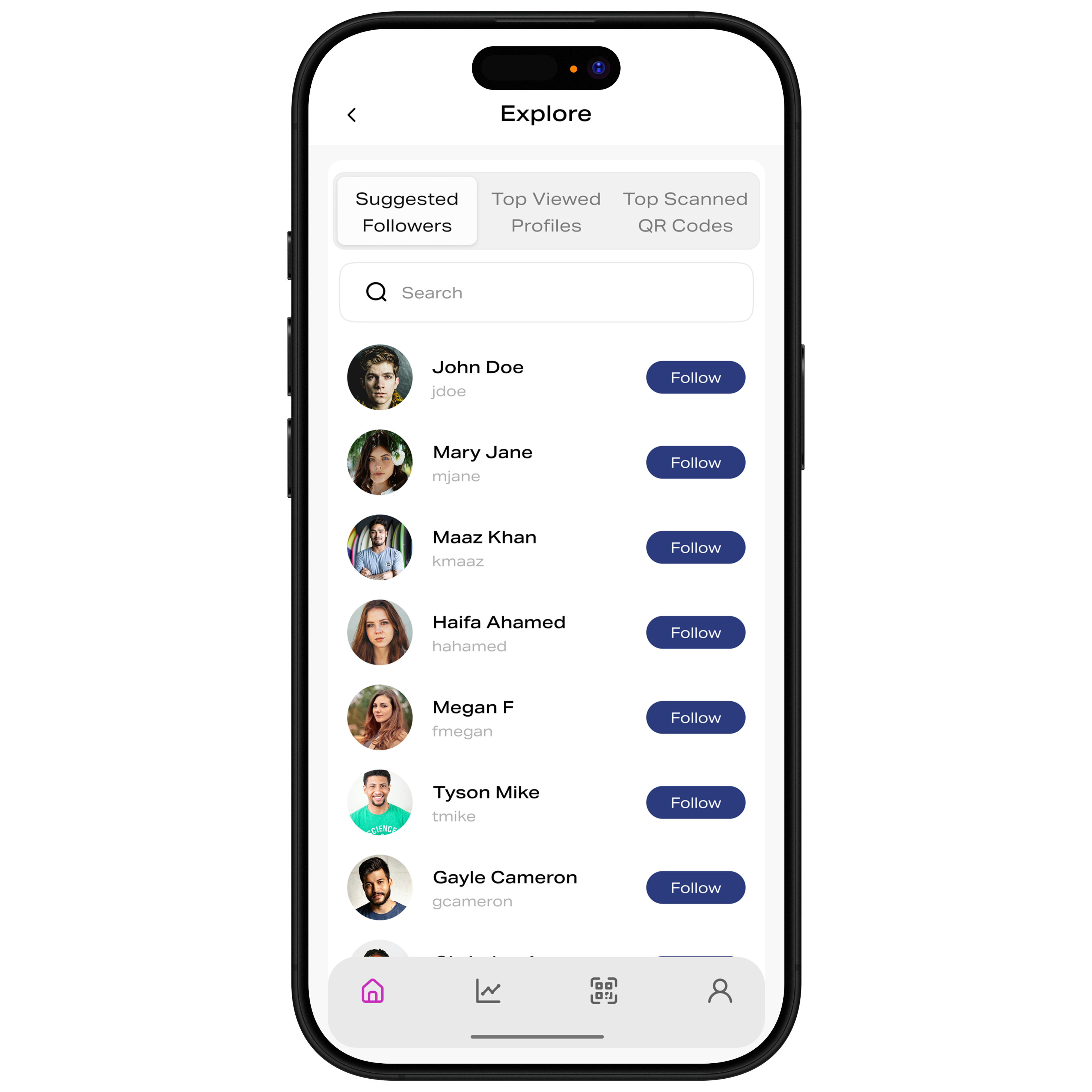
For someone attending events, the answer has to be yes on its own merits — every ticket they’ve ever bought in one place instead of buried in an inbox, offline access so a dead signal at the door isn’t a crisis, transfers to a friend without a mess, reminders before the thing starts, and the ability to follow the venues and artists they actually care about so they hear about the next one first.
For someone just looking, it’s discovery of things happening nearby, and the ability to message an organizer a direct question instead of hunting for a contact form.
The fact that this also gives a business a real audience is the point, not the trick. When the experience genuinely improves, people come back. When they come back, the audience compounds instead of decaying. That is the opposite of how impression-based marketing works, which wears out a little more every time you use it.
Simple for you, so it can be good for them
There’s a version of “all-in-one” that just means a bigger admin panel. That’s not what we’re after.
The simplification that matters is this: the effort required to give someone a genuinely good digital experience should be near zero.
Changing a menu should take thirty seconds and require no reprinting, ever. Scheduling a seasonal campaign should mean setting a date, not remembering to do it. Adding Thursday’s event to every table in the room should be one action, not a project. Selling a ticket from the Action Page someone is already on should not involve a second checkout or a second login for the buyer.
When those things are hard, businesses do the easy thing instead — the static PDF, the dead link, the campaign that never got updated. The customer experience degrades not because anyone wanted it to, but because the tooling made the good version expensive.
Make the good version cheap and instant, and people do it. That’s the entire theory. It’s also why Action Pages, Dynamic QR Codes, events, and GS1 Digital Link belong on one identity instead of a dozen logins. We wrote about what that stack actually costs an operator in You Didn’t Get Into This to Manage Four Logins.
Fees decide which experiences get to exist
This is the part operators feel most and talk about least.
A ticketing fee isn’t only a cost. It’s a filter on which events are allowed to happen at all.
When the all-in cost of selling a $15 community ticket runs into double-digit percentages — which is what a fixed per-ticket fee does to a low-priced ticket, no matter what the headline percentage says — certain events simply stop being worth running. The $10 open mic. The neighborhood workshop. The free tasting with an RSVP. The experiment you’d try once to see if anyone shows up.
Those are exactly the events that build a community, and the fee structure quietly kills them.
On Sprouter, event-ticket checkout is processed by a payment processing partner on the same flow, so the buyer is not sent to a second login. Platform and processing fees are on the Fee Schedule (effective July 21, 2026): Pro+ is 1% + $0.10 per ticket, capped at $5, plus 2.9% + $0.30 processing per order, always disclosed at checkout. Free events carry zero platform fees on every plan, including the free one — permanently. Organizers may add those lines to the buyer or absorb them. Current plan prices are on Pricing.
The cap matters more than it looks. On a $500 VIP ticket or a season pass, the platform fee stops at $5 rather than scaling forever.
What this buys isn’t only margin. It’s permission to try things. Run the free event. Price the community night at $10. Test the Tuesday series without needing it to clear a fee hurdle first. More events happen, more people come, and the ones that work tell you what to do next.
Ten years later
The thing we said in 2016 was that digital should be a shorter path between people, not a place where people get stuck.
We were early and a little naive about how long it would take. In the meantime the industry went the other direction as hard as it could — more interruption, more capture, more timers, more surveillance, more content, less signal.
Which is precisely why the moment is here now. The scarce thing is no longer attention. It’s a real person, choosing, in a real place. A scan at a table. A tap at a door. A product picked up off a shelf and turned over. Those are the last uncomplicated interactions left, and a business that handles them well doesn’t need any of the rest of it.
Sprouter exists to make those moments effortless to create, genuinely good to receive, and connected to whatever comes next.
More social. Less media. It finally means something.
Start free at getsprouter.com. Free events are free forever, on every plan.
About Sprouter
Sprouter LLC is an all-in-one engagement, ticketing, Dynamic QR, and analytics platform based in Phoenix, Arizona, founded in 2016. Sprouter combines Action Pages, Dynamic QR Codes and NFC, event ticketing, audience tools, and analytics on a single user identity, with a GS1 Digital Link resolver for connected packaging. Event-ticket payments are processed by a payment processing partner. The platform is available on web, iOS, and Android, with a separate scanner app for event check-in. Learn more at getsprouter.com.
Press inquiries: press@getsprouter.com.
Sources
- Sprouter Fee Schedule, 21 July 2026
- You Didn’t Get Into This to Manage Four Logins
- GS1 Digital Link; GS1 Sunrise 2027
Disclosures
Sprouter is not a bank. Event-ticket payments are processed by a payment processing partner. Platform and processing fees are disclosed at checkout and on the Fee Schedule; free events carry no platform fees on any plan. Fee figures reflect the getsprouter.com Fee Schedule dated 21 July 2026 and are subject to change. Cost and savings comparisons depend on plan, ticket price, volume, and fee-absorption settings; individual results vary. Digital ticket passes on Apple and Google are passes for the ticket itself, not a stored or spendable Sprouter balance. This article contains forward-looking statements about markets and product philosophy that are inherently uncertain; actual results may differ materially.