

The countdown to GS1 Sunrise 2027 has begun. By the end of 2027, every retail point-of-sale system will need to accept 2D barcodes. Every product targeting retail channels will need compliant QR codes on packaging.
Most brands are approaching this transition the wrong way.
They’re treating GS1 Sunrise as a packaging compliance exercise—update the barcode format, ensure it scans at checkout, continue business as usual. Their QR codes will technically work at the register but create zero value beyond that single function.
A smaller group of brands sees something different. They recognize that putting QR codes on every product isn’t just a supply chain requirement—it’s the largest consumer engagement opportunity in retail history. The same code required for checkout can connect consumers directly to brand experiences, content, commerce, and ongoing relationships.
This playbook is for the second group. It’s a comprehensive guide to transforming GS1 Sunrise from compliance burden into competitive advantage—the strategy, infrastructure, content, and execution required to capture the consumer engagement opportunity that most competitors will miss.
Part 1: Understanding the Opportunity
The Dual-Function Code
GS1 Digital Link is the standard that makes GS1 Sunrise valuable beyond compliance. It structures QR codes as web-enabled identifiers that serve two distinct purposes:
Retail Function: Point-of-sale systems extract the GTIN (product identifier) from the code for price lookup and checkout processing. This is the compliance requirement—codes must work at retail.
Consumer Function: Smartphones access the URL encoded in the code, connecting consumers to web-based content and experiences. This is the engagement opportunity—codes can deliver brand value.
One code. Two functions. The compliance function is mandatory. The engagement function is optional but valuable.
The Consumer Engagement Gap
Research shows 79% of consumers are more likely to purchase products with scannable QR codes that provide additional information. Consumers want product transparency: ingredients, sourcing, sustainability, usage guidance, authenticity verification.
But most brands deploying GS1 codes will provide nothing. Their codes will work at checkout and lead nowhere useful for consumers. The engagement opportunity will be wasted.
This creates competitive opening. Brands that deliver genuine consumer value from product QR codes will differentiate while competitors offer nothing. Early movers will capture consumer relationships while others focus solely on compliance.
The Relationship Asset
Direct consumer relationships are strategically valuable:
- Reduced platform dependency: Owned contacts don’t depend on algorithm favor
- First-party data: Consumer information brands control directly
- Direct communication: Marketing without intermediary gatekeeping
- Feedback channels: Consumer insights without expensive research
- Lifetime value: Ongoing relationships beyond single transactions
Connected packaging creates these relationships at scale. Every product becomes a relationship invitation. Every consumer who engages becomes a known contact.
The brands that build this relationship asset from GS1 Sunrise will have structural advantages their competitors can’t easily replicate.
Part 2: Infrastructure Requirements
The Complete Stack
Capturing consumer engagement from product QR codes requires infrastructure across multiple layers:
Layer 1: QR Management
Dynamic QR codes that can be updated without reprinting, tracked comprehensively, and routed conditionally. Requirements:
- Update destinations anytime (critical during packaging iterations)
- Track every scan with context (device, location, time)
- Route conditionally (geography, time, user segment)
- Scale to portfolio size (potentially thousands of SKUs)
Static QR codes that simply encode URLs cannot meet these requirements.
Layer 2: Landing Experiences
Mobile-native destinations that engage consumers arriving from product scans. Requirements:
- Fast loading (consumers abandon slow experiences)
- Mobile-optimized (100% of scans come from phones)
- Product-specific (relevant to what was scanned)
- Action-oriented (clear conversion paths)
- Dynamically updatable (content changes without code changes)
Generic websites designed for different contexts fail these requirements.
Layer 3: Conversion Mechanisms
Ways to transform scanners into ongoing contacts. Requirements:
- Email/SMS capture (communication permission)
- Social follows (content distribution)
- Loyalty enrollment (formal relationship)
- Community membership (peer connection)
- Preference capture (personalization data)
Information-only experiences without conversion mechanisms waste relationship potential.
Layer 4: Commerce Capability
Transaction processing for scan-triggered purchases. Requirements:
- Payment processing (cards, wallets, alternatives)
- Product/event commerce (purchases, tickets, subscriptions)
- Order management (fulfillment integration)
- Transaction analytics (commerce measurement)
Not all brands need commerce, but those with scan-to-purchase opportunities need native capability.
Layer 5: Analytics
Measurement connecting scans to outcomes. Requirements:
- Scan analytics (volume, location, time, device)
- Engagement metrics (content interaction, time on page)
- Conversion tracking (which scans produce which actions)
- Attribution (which products/placements drive value)
- Integration (connection to broader business data)
Disconnected metrics from fragmented tools can’t answer the questions that matter.
Layer 6: Settlement (for commerce)
Financial infrastructure for transaction proceeds. Requirements:
- Payment settlement (funds from transactions)
- Proceeds status (event hold, review, initiation, ACH delivery)
- Event-payment and organizer ACH payout workflow
Commerce without settlement infrastructure creates operational complexity.
The Platform Decision
Three approaches exist for this infrastructure:
Build Custom: Maximum control, maximum investment. Requires engineering resources, ongoing maintenance, and organizational capability most brands lack.
Assemble Vendors: QR tool + landing page builder + conversion platform + commerce system + analytics suite + payment processor. Creates integration complexity, data fragmentation, and operational burden.
Deploy Unified Platform: Single system handling complete journey. Reduced complexity, connected data, faster deployment.
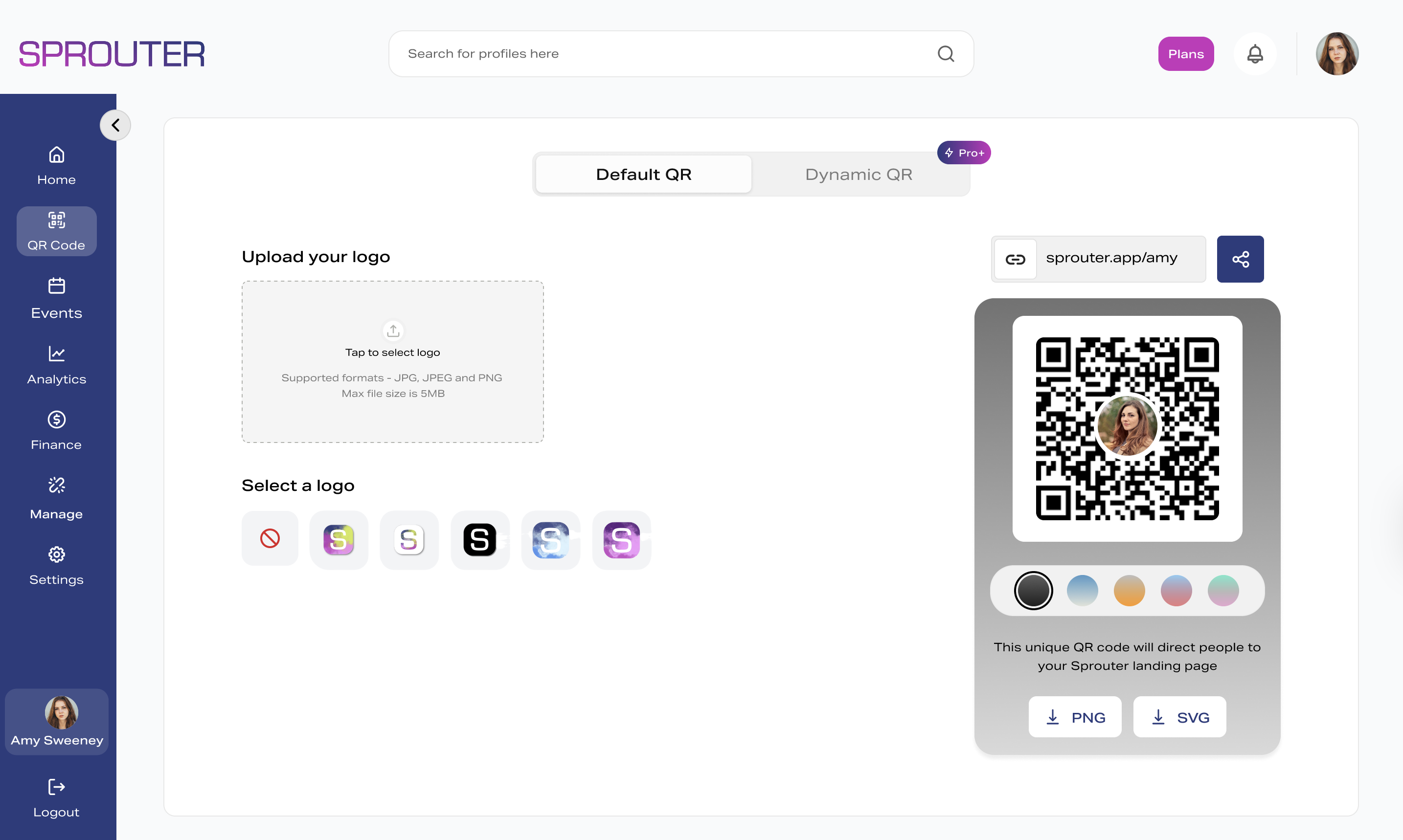
Sprouter represents the unified approach: Dynamic QR Codes, Action Pages, conversion mechanisms, event ticketing with partner-processed checkout, organizer ACH payout visibility, and unified analytics—all connected in one platform.
Part 3: Content Strategy
The Content Matrix
Product QR codes need destinations with content. For portfolios of any size, this requires systematic content strategy.
Content Types by Purpose:
| Purpose | Content Examples |
|---|---|
| Information | Ingredients, nutrition, materials, sourcing |
| Education | Usage guides, tutorials, recipes, tips |
| Engagement | Brand story, values, behind-the-scenes |
| Conversion | Offers, loyalty, community, subscriptions |
| Compliance | Safety, certifications, regulations |
Content by Product Category:
Different categories have different content priorities:
- Food/Beverage: Ingredients, allergens, recipes, sourcing
- Beauty/Personal Care: Ingredients, usage, tutorials, sustainability
- Apparel: Materials, care, styling, sustainability
- Electronics: Setup, troubleshooting, accessories, updates
- Home/Garden: Instructions, tips, maintenance, projects
The Content Production Challenge
Hundreds or thousands of products each need content. Content at scale requires:
Templates: Standardized structures that ensure consistency while enabling product-specific variation
Workflows: Processes for content creation, review, approval, and publishing
Governance: Standards for accuracy, brand voice, and regulatory compliance
Localization: Systems for multiple languages and regional variations
Updates: Processes for keeping content current as products evolve
Starting content production before 2027 deadline pressure allows quality focus rather than rushed deployment.
The Dynamic Content Advantage
Dynamic landing experiences—Action Pages that update without changing QR codes—provide ongoing content flexibility:
- Seasonal promotions overlay persistent product information
- Campaign content launches and expires on schedule
- Test variations without packaging changes
- Respond to market feedback rapidly
- Keep content fresh for repeat scanners
Static landing pages locked at deployment can’t adapt. Dynamic capability enables continuous optimization.
Part 4: Implementation Roadmap
Phase 1: Foundation (Months 1-3)
Objective: Establish infrastructure and pilot capability
Activities:
- Select unified platform or assemble vendor stack
- Configure QR management and landing experience capability
- Develop content templates and production processes
- Identify pilot products (10-20 SKUs recommended)
- Create pilot content
- Deploy pilot QR codes (can be digital/promotional before packaging integration)
Deliverables:
- Functional infrastructure
- Pilot products live
- Initial content library
- Analytics baseline
Phase 2: Learning (Months 4-6)
Objective: Optimize based on pilot performance
Activities:
- Analyze scan behavior and conversion data
- Test content variations
- Refine landing experiences based on performance
- Gather consumer feedback
- Identify successful patterns
- Document learnings for expansion
Deliverables:
- Optimized pilot experiences
- Validated content approaches
- Documented best practices
- Expansion recommendations
Phase 3: Expansion (Months 7-12)
Objective: Scale to broader portfolio
Activities:
- Expand to additional product categories
- Scale content production
- Build organizational capability
- Integrate with packaging production processes
- Develop cross-functional workflows
- Establish ongoing optimization practices
Deliverables:
- Expanded product coverage
- Scaled operations
- Organizational readiness
- Optimization processes
Phase 4: Full Deployment (Months 13-18)
Objective: Complete portfolio coverage
Activities:
- Deploy across remaining products
- Standardize processes
- Integrate with broader marketing operations
- Build advanced capabilities (personalization, commerce)
- Establish continuous improvement
Deliverables:
- Full portfolio connected
- Mature operations
- Advanced capabilities
- Ongoing optimization
Timeline to 2027
Starting in early 2025 allows completion of all phases before 2027 requirements. Starting later compresses phases and risks quality.
The competitive window for building consumer relationships before universal QR deployment narrows as 2027 approaches. Early movers accumulate advantages while late movers rush compliance.
Part 5: Measurement Framework
Core Metrics
Engagement Metrics:
- Scan rate: Scans ÷ products sold or displayed
- Unique reach: Distinct consumers scanning
- Engagement depth: Actions per scan session
- Return rate: Repeat scanners ÷ total scanners
Conversion Metrics:
- Conversion rate: Actions ÷ scans
- Contact capture rate: New contacts ÷ scans
- Commerce conversion: Transactions ÷ scans with commerce intent
Value Metrics:
- Customer acquisition cost via scanning
- Lifetime value of scan-acquired customers
- Revenue per scan (for commerce use cases)
- Relationship value (engagement over time)
Attribution Model
Connecting scans to business outcomes requires attribution infrastructure:
- QR source tracking: Which products, placements, campaigns drive scans
- Journey tracking: What scanners do after landing
- Outcome connection: How scan engagement relates to purchases, loyalty, advocacy
- Comparative analysis: Scan-acquired customers versus other acquisition channels
Optimization Loop
Measurement enables optimization:
- Analyze performance data
- Identify high and low performers
- Develop improvement hypotheses
- Test variations
- Implement winners
- Repeat continuously
Brands that build this optimization loop improve faster than those deploying without measurement.
Part 6: Organizational Readiness
Cross-Functional Alignment
Connected packaging involves multiple functions:
| Function | Role |
|---|---|
| Marketing | Content strategy, consumer engagement, brand experience |
| Digital/IT | Technical infrastructure, integration, analytics |
| Packaging | Code placement, print quality, design integration |
| Supply Chain | Packaging deployment, inventory coordination |
| Legal/Regulatory | Compliance, privacy, claims review |
| Commerce | Transaction capability, fulfillment |
No single function owns the complete initiative. Cross-functional governance is essential.
Capability Building
New capabilities required:
- Dynamic QR management
- Mobile landing experience design
- Scan-specific content creation
- Conversion optimization
- Scan analytics interpretation
- Consumer relationship management at scale
Build internal capability, partner with agencies, or leverage platform providers—but ensure capability exists.
Change Management
Connected packaging changes how organizations think about products:
- Products become communication channels
- Packaging becomes marketing asset
- Post-purchase becomes engagement opportunity
- Consumer relationship becomes brand asset
This mindset shift requires leadership communication, cross-functional education, and demonstrated value from pilot results.
Part 7: The Sprouter Solution
Why Sprouter for GS1 Sunrise
Sprouter provides complete infrastructure for the GS1 Sunrise consumer engagement opportunity:
Dynamic QR Codes: Update destinations without reprinting. Track every scan with full context. Route conditionally based on geography, time, device, or rules you define. Scale to any portfolio size.
Action Pages: Mobile-native landing experiences built for post-scan context. Fast loading, thumb-friendly, conversion-oriented. Include any combination of content, links, media, contact capture, scheduling, commerce.
Conversion Infrastructure: Email capture, social follows, community membership, event registration—conversion mechanisms native to the platform.
Commerce Capability: Event ticketing, transaction processing, commerce integration for brands with scan-to-purchase opportunities.
Unified Analytics: Connected measurement across QR scans, landing engagement, conversion actions, and commerce outcomes. Attribution that works because data never leaves the platform.
Event Payments: For event-ticket use cases, a payment processing partner processes buyer payments and controls proceeds during the event hold and payout review. Eligible proceeds are initiated by ACH to the linked organizer bank account. Sprouter does not provide a stored balance, deposit account, organizer card, or instant payout.
The Unified Advantage
Sprouter’s unified architecture provides advantages fragmented tools cannot:
- Speed: Deploy faster without integration delays
- Data: Connected measurement across complete journey
- Attribution: Real ROI calculation from scan to outcome
- Simplicity: One platform, one vendor, one learning curve
- Cost: Single subscription versus multiple tool fees
For GS1 Sunrise specifically, Sprouter handles both the compliance requirement (functional QR codes) and the engagement opportunity (valuable consumer experiences) in one integrated system.
The Decision Point
GS1 Sunrise 2027 is coming regardless of your preparation. Every product will have QR codes by requirement.
The question is what those codes do when consumers scan them.
Option A: Compliance Only Codes work at checkout. Consumers who scan find nothing. Relationship opportunity wasted. Competitors with engagement infrastructure capture the value you miss.
Option B: Compliance + Engagement Codes work at checkout AND connect consumers to brand experiences. Every scan becomes relationship invitation. Consumer data accumulates. Direct connections scale. Competitive advantage compounds.
The infrastructure investment is similar—GS1-compliant codes either way. The outcome difference is enormous.
The brands that choose Option B now—that build consumer engagement infrastructure before 2027—will own direct customer relationships while competitors scramble for basic compliance.
The playbook is clear. The timeline is known. The infrastructure exists.
The only question is whether you act.
Ready to transform GS1 Sunrise into competitive advantage? Sprouter provides complete infrastructure for the consumer engagement opportunity—dynamic QR codes, Action Pages, conversion mechanisms, commerce capability, and unified analytics. Run your compliance assessment and start building your consumer relationship asset today.